


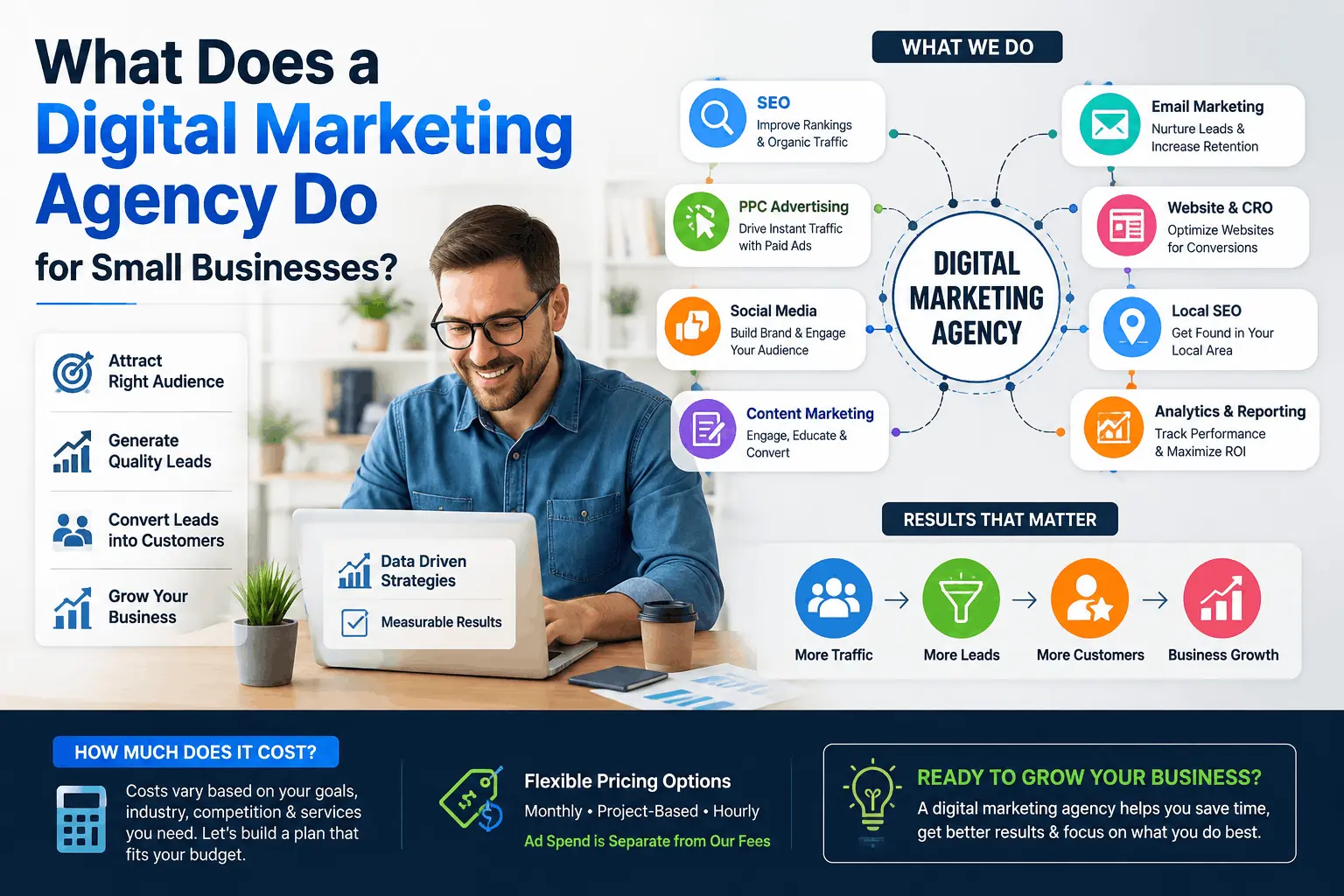
A digital marketing agency handles the ongoing work of getting a small business found online, turning that visibility into leads, and reporting back on what is actually working. That typically covers SEO, paid ads, social media, content, email, and website optimization, managed by a team instead of a single internal hire. The goal is not just more marketing activity. It is marketing that is planned, executed, and measured well enough to move the needle on real business outcomes.
If you have been researching this question late at night because you are not sure whether your business is ready for outside help, you are not alone. Most small business owners reach this point after trying to juggle a website, a Facebook page, and maybe a boosted post or two, only to realize none of it is connected to an actual strategy. This guide breaks down what an agency does day to day, what a business actually receives for its money, what results are realistic, what it costs, and when hiring one makes sense.
A full service digital marketing agency for small businesses typically offers a mix of the following, chosen based on what a business actually needs rather than a fixed package.
Search engine optimization is the work of making a website show up when someone searches for what a business sells. An agency will typically audit the site’s technical condition, research the terms customers actually use, and build out content and internal linking to target those terms over time. SEO tends to move slowly, and timelines vary widely depending on competition, the site’s existing authority, technical health, content quality, and where the business is starting from.
For businesses that serve a physical area, local SEO is often more valuable than national rankings. This includes optimizing the Google Business Profile, building consistent citations across directories, and collecting reviews. A plumber in Austin does not need to outrank national brands. They need to outrank the other five plumbers within a short drive.
Pay per click advertising can place a business prominently in search results or in front of a targeted audience on advertising platforms, in exchange for a cost per click or impression. Agencies manage bidding strategy, ad copy, landing pages, and budget allocation. PPC is usually the fastest channel for generating traffic, since campaigns can go live within days, though early performance often improves as the account gathers data and gets optimized.
This covers content creation, posting schedules, community management, and sometimes paid social campaigns. The value here is not just visibility. It is the trust signal a well kept profile sends to someone checking a business out before they call.
Blog posts, guides, videos, and downloadable resources built to answer the questions customers are already asking. Good content marketing does double duty. It supports SEO rankings and it positions a business as one that genuinely understands its industry.
Automated welcome sequences, promotional campaigns, and lifecycle emails that keep past customers coming back without requiring new ad spend every time. Email is generally considered one of the more cost effective channels, largely because the business already owns the list, though actual returns vary by industry, list quality, and offer.
A website that loads slowly or confuses visitors undoes everything else an agency does. This service includes redesigns, speed improvements, mobile optimization, and building landing pages specifically for ad campaigns.
Traffic is only useful if it converts. CRO involves testing headlines, forms, calls to action, and page layouts to increase the percentage of visitors who take a desired action, without necessarily spending more on traffic.
Lead generation is where the individual services connect into a single outcome: turning marketing activity into actual inquiries, calls, form submissions, or bookings. Depending on the business, this can involve choosing the right traffic sources, building landing pages designed around a specific offer, setting up forms or booking tools, tracking calls, and mapping out the full path a visitor takes from first click to becoming a lead. An agency working on lead generation is essentially connecting SEO, paid ads, and the website into one system, then measuring where leads come from and where prospects drop off along the way.
An agency should be able to show where leads are coming from and how that connects to activity across channels, not just impressions or followers. If a report only shows surface level metrics with no link to business outcomes, that is worth asking about directly.
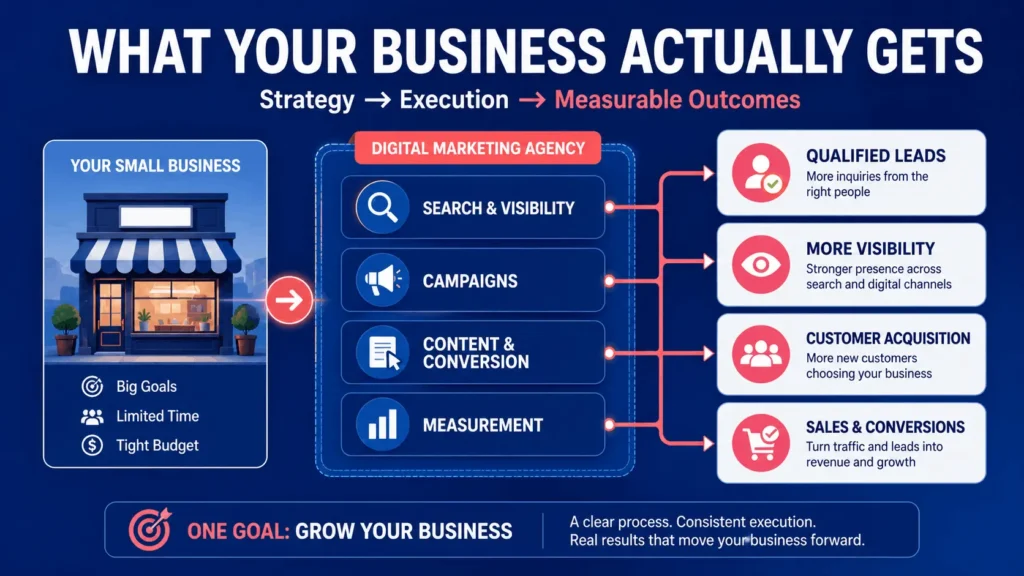
Services describe the categories of work. Deliverables describe what actually lands in a client’s inbox or dashboard. Understanding the difference helps clarify exactly what a business is paying for.
Depending on the scope of work, a small business can typically expect to receive things like:
Not every engagement includes all of this. A business paying for a narrow scope, such as local SEO only, should expect a smaller set of deliverables focused specifically on that channel. Part of a good onboarding conversation with any agency is getting clear, in writing, on exactly which of these a client will actually receive.
Beyond the list of services, the real value is in how an agency approaches the work. Most competent agencies follow some version of this process.
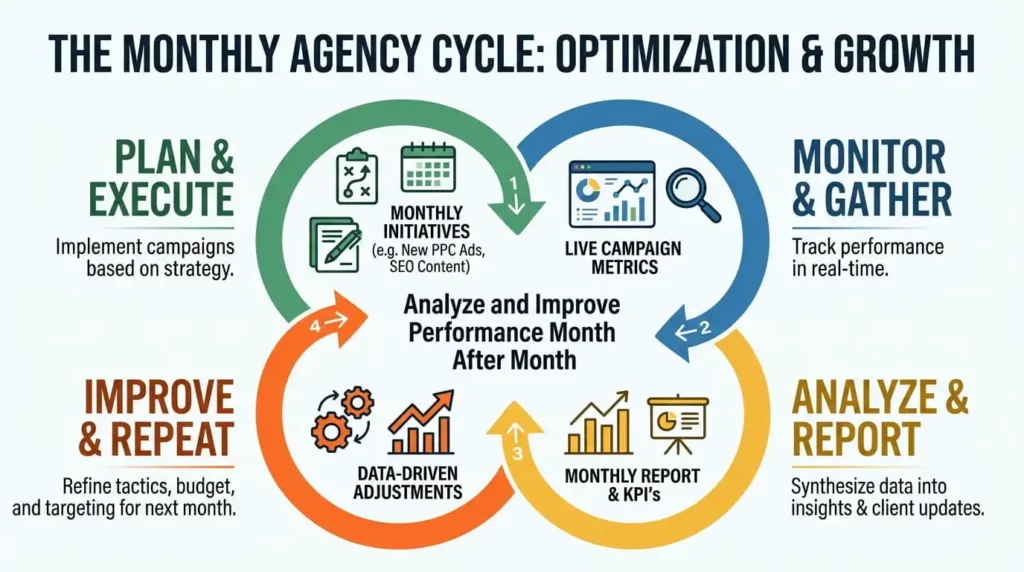
This cycle repeats continuously. It is why relationships with a digital marketing agency for small business tend to work better as ongoing partnerships than one time projects. A campaign built once and never revisited rarely performs as well as one that gets refined based on real results.
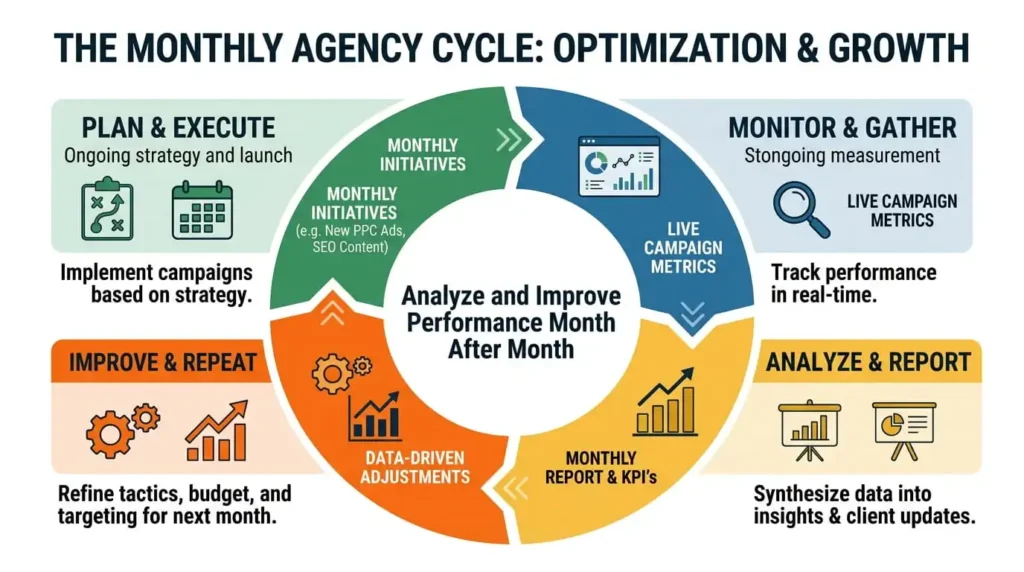
The exact work depends on the services a business pays for, but an ongoing digital marketing engagement usually follows a repeating cycle of execution, measurement, and improvement.
The first month often involves:
Once the foundation is in place, the agency begins putting the strategy into action. This may include:
Ongoing marketing is not simply repeating the same tasks every month. The agency should use performance data to decide what to improve next.
This can include:
The exact monthly workload should always be defined in the agreement. A business paying for local SEO should not expect the same deliverables as a company paying for SEO, paid advertising, content, social media, and conversion optimization.
Expect an onboarding period of two to four weeks where the agency gathers access to accounts, researches the market, and builds an initial strategy. After that, most agencies settle into a regular monthly rhythm: campaign execution, a check in call, and a performance report.
Communication cadence varies by agency size. Smaller shops often give more direct access to the people actually doing the work. Larger agencies may route communication through an account manager, which can mean slower answers to specific questions but sometimes more resources behind the scenes.
No legitimate agency can promise identical results for every business, because outcomes depend on far more than the agency’s effort alone. That said, it helps to understand what each channel is generally capable of producing when it is working well.
The actual results a specific business sees are shaped by a combination of factors: the level of competition in its market, the budget behind the effort, the quality and speed of the website, how compelling the offer itself is, the state of the business’s online presence when the work begins, how well the campaigns are executed, whether tracking is properly set up, and simply how much time has passed. Two businesses in the same industry can invest the same budget and see different outcomes because of any one of these variables.
Digital marketing agency cost for a small business generally falls into a few common pricing structures, and the right one depends on the type of work involved and how predictable the budget needs to be.
| Pricing model | How it works | Typically used for |
|---|---|---|
| Monthly retainer | A recurring fee for ongoing, continuous work | SEO, social media, content, and account management |
| Project based | A flat fee for a defined, one time deliverable | Website builds, brand refreshes, audits |
| Hourly or consulting | Billed by time spent on strategy or advisory work | Strategic guidance without full execution |
| Advertising spend | Paid directly to the ad platform, separate from agency fees | Google Ads, Meta Ads, and similar campaigns |
There is no single price that applies to every small business. Current industry guides put small-business digital marketing at widely different levels, largely because the scope can range from one focused service to a full multi-channel strategy. For example, Landingi currently puts small-business digital marketing at roughly $2,000–$6,000 per month, while noting that some businesses spend considerably more depending on their goals, industry, and channel mix.
For planning purposes, the most useful way to think about the budget is by scope:
| Approach | Typical planning range | What it usually covers |
|---|---|---|
| One focused channel | $500 – $2,500+/month | SEO, local SEO, social media, email, or another single service |
| Several coordinated channels | $1,000 – $3,000+/month | A combination such as SEO, content, email, or paid advertising management |
| Full-service marketing | $2,500 – $12,000+/month | Multiple channels, strategy, execution, reporting, and ongoing optimization |
These are planning ranges, not fixed prices. Actual costs vary based on the number of channels, industry competition, location, required creative or website work, and growth goals.
Keep in mind that agency fees and advertising spend are separate. The agency fee covers strategy, management, and execution, while ad spend is paid directly to platforms such as Google or Meta.
Freelancers often cost less than agencies but usually specialize in fewer areas. A full agency-style service may require multiple freelancers, which can add coordination and management costs.
The timeline depends heavily on the channel, the competition, the business’s starting point, and how quickly changes can be implemented.
Paid advertising can begin generating traffic and potential leads soon after a campaign launches, although performance often needs several rounds of testing and optimization before the agency can identify what works best.
Social media usually takes longer to build meaningful awareness, engagement, and trust because the audience develops over time.
SEO is generally slower. Improvements can sometimes appear relatively quickly, particularly when fixing technical problems or targeting less competitive opportunities, but meaningful organic growth often takes months rather than days.
The important point is that different channels should be judged against different timelines. An agency promising guaranteed SEO results or instant, predictable growth across every channel deserves careful scrutiny.
Whether a digital marketing agency is worth it depends on where a business is right now, not on marketing theory in general. It is a fair question, and the honest answer is that it varies by situation.
An agency is generally a good fit when a business:
An agency may be a weaker fit when a business:
The businesses that tend to get the most value from an agency usually already have a working product or service and some revenue coming in, and simply do not have enough hours in the day to market it properly themselves.
No credible article on this topic should pretend digital marketing carries no downsides. It has real limitations worth knowing before committing budget.
None of this is a reason to avoid digital marketing altogether. It is a reason to go in with realistic expectations instead of assuming it works automatically once budget is committed.
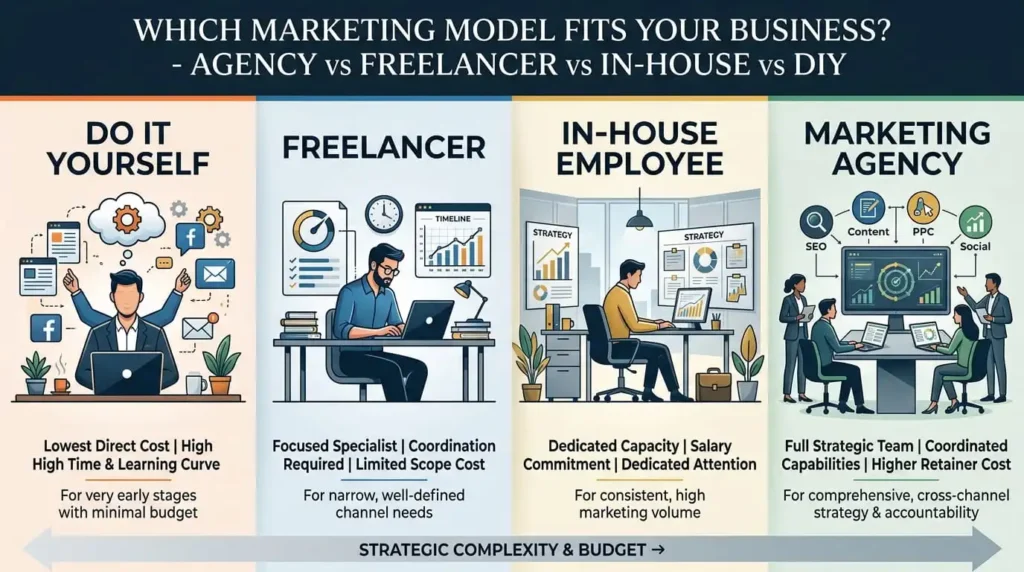
| Option | Best for | Cost structure | Main advantage | Main tradeoff |
|---|---|---|---|---|
| Digital marketing agency | Businesses needing multiple channels managed with strategy and accountability | Retainer, project fee, or hourly, plus ad spend if applicable | A full team and coordinated strategy across channels | Generally higher cost than a single freelancer |
| Freelancer | A narrow, well defined task in one specialty | Hourly or per project | Lower cost for a specific, limited scope | The business must coordinate across multiple specialists itself |
| Internal hire | Businesses with steady, high enough marketing volume to justify a salary | Salary plus benefits and tools | Full time focus dedicated only to that business | Slower to build deep expertise across every channel alone |
| DIY | Very early stage businesses testing an offer with minimal budget | Time investment plus tool costs | Lowest direct cost | Requires real time investment and a genuine learning curve |
There is no version of this comparison where one option is automatically correct. Outsourced marketing for small businesses, whether through an agency or a freelancer, tends to make sense once the cost of not doing it, in the form of missed leads and stalled growth, outweighs the cost of paying someone else to do it properly.
Start by asking what channels an agency actually specializes in rather than what they claim to handle. A shop that is genuinely strong in local SEO is not necessarily the right fit for a business that mainly needs paid social work. Ask for examples of work with businesses similar in size and industry, and ask how performance gets reported, specifically whether reports connect back to leads and business activity or stop at traffic and impressions.
Get clarity on contract terms before signing. Arrangements that can be ended on a monthly basis generally signal more confidence from an agency than one that requires a long commitment upfront. Ask directly who will actually be doing the work, since some agencies staff senior strategists on calls but hand execution to junior team members or subcontractors.
One issue that gets overlooked often enough to call out separately is account and asset ownership. Before signing anything, a small business should understand who owns and controls the important assets involved, including the website and domain, the Google Business Profile, advertising accounts, analytics accounts, creative files, written content, and social media accounts. Ideally, these should be owned by the business itself, with the agency granted access rather than holding ownership. This matters most if the relationship ever ends, since a business that does not control its own accounts can lose access to years of history, reviews, and campaign data.
Before signing a contract, make sure you can answer these questions clearly:
Getting these answers in writing before work begins can prevent many of the problems that arise later in an agency relationship.
Part of choosing well is understanding the difference between what an agency controls, what it can influence, and what depends on the client or the market. No legitimate agency can promise a specific Google ranking, a specific amount of revenue, instant SEO results, content going viral, an unlimited volume of leads from a very small budget, or a fixed return regardless of the product, pricing, or offer behind it.
An agency generally controls the quality of strategy, execution, and reporting. It can influence traffic, visibility, and lead volume through that work, but it does not control what happens once a lead reaches the business, whether that is a fast follow up call, competitive pricing, or a genuinely strong offer. Those factors sit with the client, and they affect results just as much as the marketing itself.
AI has changed how agencies work, without replacing the core reason businesses hire them. Tools increasingly support research, content production, reporting, ad variation testing, workflow automation, and basic data analysis, work that used to consume hours of an account manager’s week.
What AI has not replaced is judgment: deciding which channels deserve budget, understanding the specific nuance of a business’s market, making creative and brand decisions, and taking responsibility when a campaign underperforms. A tool can generate several headline variations in seconds. It still takes a person to decide which one actually fits the brand, interpret why results moved in a certain direction, and be accountable for the outcome. As AI capabilities continue to expand, that combination of context, judgment, and accountability is likely to remain the part of the work that is hardest to automate.
It plans, builds, and manages the channels that get a business found online, including SEO, paid ads, social media, content, email, and website work, then reports on results and adjusts the approach over time.
Most offer some combination of SEO, PPC, social media management, content marketing, email marketing, website design, conversion rate optimization, and analytics, tailored to what a specific business needs.
Not always. It depends on budget, how many channels need managing, and whether anyone internally already has the time and skill to do the work well.
Costs vary based on scope and pricing model. Common structures include monthly retainers, project based fees, and hourly consulting, with advertising spend billed separately from agency fees.
Mainly time and expertise. Managing SEO, ads, content, and analytics well requires skills most business owners do not have time to build while also running the business day to day.
Yes. Costs can strain a tight budget, results such as SEO take time to build, and quality varies between agencies, which makes vetting important before signing anything.
No. AI is speeding up execution tasks like research and reporting, but strategy, creative judgment, and accountability still depend on human decision making.
An agency typically brings a coordinated team across multiple channels and manages strategy alongside execution. A freelancer usually covers one specialty, which works well for a narrow task but requires the business to coordinate across specialists if more than one skill set is needed.
Yes, particularly in the early stages. The tradeoff is time and a real learning curve, since channels like SEO and paid ads have genuine technical depth that takes time to master properly.
A digital marketing agency can be genuinely valuable when a small business needs expertise it does not have internally, consistent execution across multiple channels, better measurement of what is actually working, or simply more capacity than an owner or a small internal team can provide. It is not automatically the right choice for every business, and the businesses that benefit most tend to have a working offer, some revenue already coming in, and a clear reason they cannot execute marketing well on their own.
If you are trying to decide whether outside help makes sense for your business, start with your current situation: what you want to achieve, which channels you need, what you can realistically spend, and whether you have the time and expertise to manage the work yourself.
Yana Digital Solution can help you review those factors and identify what approach makes the most sense for your business. That could mean a full digital marketing engagement, a focused project, or simply a clearer plan for handling the work yourself.


Comments are closed